Monday, February 15, 2010

Shillong December 24-25

On Thursday December 24, my day started off with relief when Rev. Pachuau was kind enough to go to a nearby taxi station to retrieve my cell phone that had dropped out of my jacket pocket in the van we were in yesterday. After that problem was resolved, I did some sightseeing in the morning. I went with his two sons to the Don Bosco Ethnographic Museum only to find it closed on Christmas Eve. We then went to a butterfly museum, which was open, and then went to the public library, which also was closed.
The Butterfly Museum

After that excursion I walked around the city and went to the main Roman Catholic cathedral. It was recently painted blue and had a nice Stations of the Cross processional way.

The Roman Catholic Cathedral

One of the Stations of the Cross

I also went to an internet place, got some prints made from the photographs of the past two days, and bought some more video CDs at Planet M in Troop Bazaar. That evening I went with Rev. Lalramliana Pachuau’s family to the Mizo church for a service at 7:00, followed by carol singing and a communal meal until 10:45. That evening for me was the highlight of the Christmas holiday.

The next day, Christmas, I joined Rev. Pachuau’s family for breakfast. We then went to a church service at 10:00. After the service ended at 11:15 I picked up the photo prints that I had ordered yesterday and returned to the church in time for the second service at 1:30, which ended at 3:00. After tea I went to Rev. Pachuau’s apartment for dinner, before leaving for a service at another Mizo church in another part of the city at 6:00. The temperatures there were hovering just above freezing. After the service we had tea and then made a social visit. I got another nice shot of Rev. Pachuau and his wife Marovi on that occasion.

Rev. Lalramliana Pachuau and his wife Marovi. Note the charcoal heater at their feet

That evening back at the PCI guest room, I copied onto my laptop computer a number of video CDs of the popular Mizo Gospel singer Lalruotmawi that I had borrowed from Rev. Pachuau. Getting some CDs of her music was one of my objectives in the trip, since my father finds her music particularly attractive. She sings her Gospel songs to American Country-Western-style music; some samples can be found on Youtube. In the Presbyterian Mizo church services I have been to, however, they sing hymns to more traditional Mizo melodies, using the tonic solfa method of notation. The Mizo language is written using the Latin alphabet. One of the few words of Mizo that I have learned is “Lal”, meaning Lord or King, and is used in many personal names.

Mawlynnong December 23

On Wednesday December 23 I went sightseeing again. There was mix-up about the van and driver, so Zovi, a friend, the teenage children of Rev. Pachuau, and I did not get underway until after 11:00. My friends had mostly not been to any of the places we visited today or yesterday.

We went to Mawlynnong village, an eco-village that advertises itself as the cleanest village in India, if not Asia. They have waste baskets all along the various paths in the village, although I did spot a pile of trash behind one rock. The villagers have set up a bamboo lookout tower with a view down to the plains just across the border into Bangladesh. The landscape has lush vegetation, a sharp contrast to yesterday.
Mawlynnong village with the waste baskets

The bamboo lookout tower with some trash behind the rock

Me with Bangladesh in the background

We then went to see a balancing rock outside the village.

The Balancing Rock

Then we had picnic lunch of rice (what else?) before going to a most remarkable living root bridge formed out the roots and trunks of a number of trees.

The picnic lunch

The Group at the Living Root Bridge

The Living Root Bridge

The Living Root Bridge

On the way back in Shillong we got stuck in a traffic jam that delayed our return for about an hour and a half. Once back at the PCI building, I joined a church fellowship group in the apartment of Rev. Pachuau. It happened to be his and his wife Marovi's 25th wedding anniversary.

The fellowship group. Rev. Lalramliana Pachuau is playing the guitar and his wife Marovi is next to him in the red shawl.

Cherrapunji December 22

On Tuesday December 22 I went sightseeing. I hired a van with a driver for the day and Zovi, her sister and her friend Sony and four of the teenage children of Rev. Pachuau joined me. We went to Cherrapunji, the place that receives the highest annual rainfall of any place on the planet at more than 11 meters / 450 inches per year and more; in one peak year there was 23 meters / 900 inches of rainfall. The title however is disputed with the nearby village of Mawsynram. We first stopped near Cherrapunji village at the Nohkalikai Falls, the fourth-highest waterfall in the world.

The Nohkalikai Falls

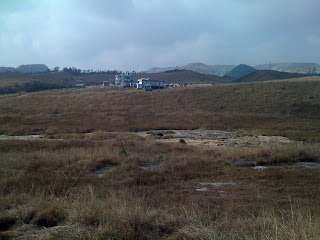
Cherrapunji is just about the most bizarre place I have ever been. Even though it receives more rainfall than anywhere else, the area suffers from drought, with only dried-out low-lying scrub brush to be seen. Meghalaya as a whole consists of a high mountain plateau. Cherrapunji is on the edge of the high plateau, right where the plateau drops off at an exceptionally high sheer cliff, as the photograph of Nohkalikai Falls shows. During the summer months of the monsoon season, moisture-filled winds blow up from the Bay of Bengal across the wide, low-lying plains of Bangladesh but are then funneled into narrower valleys and then hit the cliffs. The winds are pushed up and rapidly cool to produce uniquely heavy torrential downpours in the immediate area. That makes perfect meteorological sense.

But why the area is so dry remains a mystery, since I have not been able to find anything on the internet that explains that satisfactorily. Deforestation is cited as a cause, but that does not make much sense, because it does not explain why there seem to be no lakes, ponds or water reservoirs in the area. It seems that the locals do not harvest much of the rainfall to use throughout the year. Instead they have to have water brought in by tanker truck for much of the year. It only rains during the monsoon months, and not much during the rest of the year (there was some fog, but no rain during my week in Shillong).

I do not know how much more forested the area was in the past, but today the only trees around are in sheltered low-lying areas or on the mountain slopes. In most areas the ground surface consists of bare bedrock with only the thinnest of soil covering.

The landscape around the Nohkalikai Falls

We then went to the nearby Mawsmai natural cave, which extended for a couple hundred meters.


The group at the entrance to the Mawsmai Cave

The group in the Mawsmai Cave

Along the way to the Mawsmai Cave I spotted a store identified as a cement dealership. In an episode of intercultural bewilderment, my friends just could not understand why I found it odd to note the other sign advertising pure honey for sale. They recognized of course that the store was in fact a general store that sells a variety of products, not just the combination of cement and honey that is advertised.


The cement dealership that also sells honey

We then went to the nearby Mawsmai Eco-Park, where I saw the first foreigner since leaving Delhi; throughout the week I only saw a handful of foreigners in Shillong. Here again the landscape is drier than even the bleak prairie of South Dakota, where my father grew up on a farm.


The Mawsmai Eco-Park

The Mawsmai Eco-Park

The Mawsmai Eco-Park with some ancient monoliths

But one indication of the amount of rain that can fall during the monsoon season is the walk-way bridge over a water course that is now nearly dry.

The Mawsmai Eco-Park Bridge

On the way back, we stopped at the Elephant Falls on the outskirts of Shillong.

The Elephant Falls

We also stopped at a scenic outlook over the city of Shillong, but it was too misty and cloudy to see much of anything.

Sunday, February 14, 2010

Shillong December 20-21

I began my week-long stay in Shillong by walking around the neighborhood in the morning of Sunday December 20, before returning to the Presbyterian Church of India building, where I met the family of Rev. Lalramliana Pachuau, the administrative secretary, who lives in an apartment in the building. I went with them to the 10:00 church service at the nearby church of the Mizo community, where I met Zovi. After the hour-long service, I chatted with people and then I walked around the city center with Zovi and a friend of hers. We stopped at the Ward’s Lake public park and paid a social call on a family, before ending up at another Presbyterian Church of India building where Zovi lives. We talked about my plans for the next week, and then I returned to my hotel.

Zohmangahi Rokhum aka Zovi or Zohmai
The Presbyterian Church of India building where she lives

My friend Zovi and most of the people I met during my time in Shillong are Mizos, the principal ethnic tribal group in the nearby Northeast state of Mizoram, who are in Shillong for work. I had met Zovi in April of 2006, when I traveled to Mizoram to meet Terini, one of my students at the Henry Martyn Institute during the 2005-2006 academic year, and we stayed in contact. I had wanted to make another visit to the very interesting Northeast states of India, and things fell into place for me to come to Shillong to visit her now. Zovi started working for a women’s outreach program at the Presbyterian Church of India office a few months ago.
A photo from April 2006 in Aizawl, Mizoram. Zovi is in the yellow dress on the far right and Terini is in the red blouse on the left.

The next day, Monday December 21, I decided to check out of my hotel and move into the guest room of the PCI building. My small hotel room was unpleasantly cold; there being no heating and since it faced north, no chance for sunshine to warm the room up in the daytime; overnight lows dropped down close to freezing. Also there was no food available at the hotel, so there was no reason to want to stay there rather than in the guest room at the PCI building, which was warmer, more spacious with a private bathroom and cheaper as well – US$6.50 versus $11 per night. I ate meals a number of times at a nice enough Chinese restaurant up the street and also bought supplies of snacks to eat.

After checking into the PCI guest room, two of the sons of Rev. Pachuau went with me to the Troop Bazaar shopping district in the city center. I walked around and stopped at a Planet M music and video chain store, where I bought a number of movies in video CD format, which at about US$3-4 per movie, is much cheaper than DVDs. I returned to the PCI building at 3:00 to meet Zovi. We went to a nearby friend’s house to join a group paying a Christmas visit to a children’s hospital in the city. However, it turned out that there were no Mizo children patients in the hospital, so we soon returned to the friend’s house for a meal and conversation.

Afterwards I walked around until finally, after having searched for the past couple of days, I found an internet outlet. But I was only able to use the internet for short while before it closed at 6:00. So I walked around until I eventually found another internet outlet, only to have it close at 7:30, shortly after I arrived.

One thing that surprised me about Shillong is the overwhelming prevalence of English. Virtually all shop signs are in English only; only a very few government office have signs in Hindi as well. One sign that amused me was an advertisement for “Indian Made Foreign Liquor”. As was explained to me, that means foreign-type, distilled alcohol produced elsewhere in India, rather than the local varieties of moonshine.

The Indian Made Foreign Liquor sign

Saturday, February 13, 2010

India December 18-19

I traveled to India over the Christmas and New Year’s holiday. I flew from Frankfurt to Delhi on the morning of Friday December 18. There was a horrendous line at the Air-India check-in counters, due to some cancelled flights, but everyone eventually got on their flights.

In line I struck up a conversation with a fellow passenger, whom I ended up sitting next to for the flight. He turned out to be Parimargan Nagi, a professional chess player who recently reached the rank of international grandmaster at the youngest age ever – 12. He is still in high school and so has not fully launched his chess-playing career. We had a delightful conversation about Muslims in India; my copy of Diane’s dissertation serving as a conversation piece, and we also chatted about chess. I have not played much chess since high school.

The flight left Frankfurt about a half hour late and arrived in Delhi at 11:00 pm. I decided to hang out at the airport. By coincidence Diane D’Souza and her companion Art, whom I had just met in Amsterdam, were traveling to Delhi on another flight that arrived at 1:00 am on Saturday December 19, so we met up and chatted for the few hours until we checked into our respective onward flights. My flight to Guwahati, in the Northeast state of Assam, left at 8:45 and arrived at 11:00 am. I was the only non-Indian on the flight.

My friend Zovi had sent me an SMS that there was a state-wide protest strike scheduled in the neighboring state of Meghalaya, so I was not sure how to continue on to Shillong, the capital city of Meghalaya and my destination. There is no airport in Shillong, so the options were a three or four-hour bus or taxi or a thirty-minute helicopter service. I initially inquired about the helicopter, but it was fully booked. But a few minutes later, the ticket person came running after me to tell me that there were in fact seats available, because some passengers had cancelled their reservations due to the protest strike. So I got a ticket for the 12:30 flight to Shillong.

I began to get concerned about what I was getting myself into when I and another clueless non-local turned out to be the only passengers on the seven-seater helicopter. But the flight went as scheduled, and there proved to be nothing untoward going on in Shillong.

I took a local bus into the bus station, where my friend Zovi met me. She took me to the Presbyterian Church of India building, where she works, and we discussed lodging options. There was a guest room at the PCI building, but because there was no food available, she thought that the nearby Best Holiday Inn was a better option, so we went there and I checked in at 5:00. I spent the rest of that evening and night getting caught up on sleep.

The Presbyterian Church of India building in Shillong

Amsterdam December 16-17

I traveled to Amsterdam to attend the PhD oral defense of Diane D’Souza, a colleague from the Henry Martyn Institute. Her thesis, entitled Partners of Zaynab was about the 12er Shi‘ite community in Hyderabad, focusing on women’s devotional practices. The published book version will be out in a few months.

I took an overnight train to Amsterdam with a supersaver fare that arrived at 11:15 on Wednesday December 16. I proceeded to the campus of the Free University of Amsterdam in good time for the defense at 1:45.

Diane had contacted me two days earlier about whether I could serve as her paranymph for the ceremony; the person she had lined up was unable to attend at the last minute. A paranymph was a new vocabulary word for me, designating a ceremonial assistant equivalent to best man or bridesmaid at a wedding. I was supposed to have a black suit with tails and a white bow tie, so when I arrived with only a black three-piece suit and tie, there was some extended discussion about whether I could serve as paranymph and join the procession in and out of the auditorium with the candidate. Since there was no one else available, the mistress of ceremonies eventually relented and allowed me to take part. Diane’s other paranymph was Yasmin Nourdin, a South African now living in Sweden, who had been with the conflict resolution program at the Henry Martyn Institute.

Me as paranymph, with Diane in the middle, Yasmin on the right and the upholder of sartorial standards in the background

The oral defense was far more ceremonial than my experience in American universities and consisted of a presentation by the candidate and some questions posed by a panel, followed by the graduation ceremony and awarding of the diploma on the spot. After the ceremony, there was a reception and then a dinner at the fancy Memories of India restaurant.

I stayed in a hotel in the city center near the Rembrandt Square park, which was okay until snow started to fall during the night, leading lots of party-revelers to whoop it up in the park. Another drawback was that the hotel proved not to have an internet connection.

The next day, the Free University of Amsterdam organized an afternoon seminar on Shi‘ites, taking advantage of so many specialists in the field who were around to participate in Diane’s defense the previous day. I was able to attend the first session, but then had to leave to catch my train back to Frankfurt, which was delayed due to snow. I stayed in a hotel near the train station. Their internet was not functioning, so after a couple of days without access I had to go to an internet place in the train station the following morning.

Bamberg November 23-December 15

I arrived back in Bamberg mid-day on Monday November 23 and the following weeks until mid-December were routine. The weather turned cold, with some days dropping below freezing. During these weekends between my trip to the USA and my forthcoming trip to India over Christmas I did not travel anywhere. Instead I stayed in Bamberg on weekends.

I continued to work on the sites and monuments of Jerusalem project. My colleague Hanswulf Bloedhorn came from Tübingen on December 10 and 11 to discuss progress with Klaus and me.

My forthcoming book with the University of Jordan press about Palestinian customs and practices has reached page-proof stage, and so I spent some time proofreading it and preparing an index.

I also continued to teach my course of the history and archaeology of Syria-Palestine in the Byzantine and Early Islamic periods. By chance in December there were two public lectures about the archaeological excavations at the site of Rusafa in Syria, of prime interest for the course. I also attended a public lecture by Nicholas Jaspert on interfaith encounters in the Mediterranean; I had first met him in Jerusalem last March.

I continued to participate in the Volkshochschule (community college) courses: Greek dancing on Mondays, Conversational French on Tuesdays and Irish Step Dancing on Wednesdays; there was also an additional Irish dance session at a local pub on Sunday December 13.


The Irish Set Dance Group

I also attended a number of other cultural events, including two lectures sponsored by the local nature society, and a number of music concerts during the Advent season. I also attended a presentation about a charitable project in India. Once Advent started, the annual Christmas Market was set up in the main city square.


The Christmas Market in the Maxplatz Square

I also read the suspense novel by Frank Schätzing, Die Schwarm (The Swarm), the first thousand-page novel I have read in German. It was an easy read about a mysterious intelligence in the ocean attempting to get rid of the human species: whales start sinking ships, tube worms bore into the continental shelves, causing them to collapse and provoke tsunamis, while crabs spread a pandemic disease.