Friday, November 30, 2012

Madaba and Amman October 7-15

After the trip to the Kerak Plateau, I spend the next days in Madaba to check some details at the Madaba Archaeological Park for the report that I have been working on. I stayed at a local hotel in Madaba.

I had received a permit from the Department of Antiquities and on my first day, Sunday October 7, I introduced myself to the directors of the Madaba offices of the Department of Antiquities, Ministry of Tourism and the Madaba Mosaics School.

The next day I went to the Madaba Archaeological Park and took some notes at the Church of the Prophet Elias and the Burnt Palace. In particular I took measurements of the density of the tesserae (number of cubes per ten square centimeters) in the various mosaic floors around the site.

The Tyche with 160 mosaic cubes per ten square centimeters

On Tuesday October 9, I came to Amman to attend a day-long conference at the Department of Antiquities about the Umayyad Desert Castles.

On the fourth day, Wednesday October 10, I took further notes at the Archaeological Park, especially checking what the various photographs from the 1992-1993 excavations actually show. The weeds and trash at the site of the Archaeological Park had been removed recently, leaving the site the cleanest I had ever noticed it. A shelter over the Church of the Martyrs is currently under construction. That afternoon I came to Amman and moved back into ACOR.

The shelter at the Church of the Martyrs

Back at ACOR, I worked on a variety of projects to wind things up during the final days of my current stay in Jordan. In response to an email from the Archaeological Survey of India about missing elements of my application for my planned survey of heritage buildings in Bhimunipatnam in February, I worked further on my proposal, but I was unable to get everything in order before a critical application deadline. So it looks doubtful that the project will get a permit this year.

I also proofread the upcoming issue of the Jordan Journal for History and Archaeology and my Masjid al-Aqsa article for Humberto da Silveira’s book. On October 13, Nadia Sukhtian invited Isabelle Rubin and me to her place to discuss work on the Gustaf Dalman translations, and on October 14 I attended a meeting about the UNESCO Baptism Site World Heritage application. On October 15 Mohammad Ghosheh came by to discuss his new book about the Dome of the Rock; we went to a fancy Japanese restaurant and then he took me to the airport for my overnight flight to Frankfurt.

Kerak October 6

On October 6, Firas, Ana and I spent a second day visiting sites with Byzantine churches in the Kerak Plateau.

In the morning we first went to the city of Kerak to see the modern Roman Catholic church and we saw the basement apartment there where Firas and his parents had once lived.

Firas in the church basement

We also stopped by the Greek Orthodox church, but no one was there.

We then spent the rest of the day seeing sites in the north Kerak plateau. We went to the town of Adir, north of Kerak, where we saw the modern Roman Catholic church and a cave of no particualar importance in the compound; we then saw the Greek Orthodox church there.

The cave in the Roman Catholic compound in Adir

We then went to the uninvestigated site of Khirbat Da‘udiyah and then the major Roman and Byzantine ruins in the city of al-Rabba, with a large church in the middle of the site.

The church at al-Rabba

We then proceeded north to the site of Tadun, where we saw some recent illicit digging in the large unexcavated church there.

The illicit digging at Tadun

Next was the church site at Ja‘dat al-Jabur, which has suffered badly since I had worked briefly there in 1994 and 1996, and the nearby uninvestigated church at al-Dann wa-al-Baradan.

The church at Ja‘dat al-Jabur

The church at al-Dann wa-al-Baradan

The next site was the hilltop of Shihan with its church. The Georgian project to work there that I had a tangential role in a few years ago never got off the ground.

The ruins at Shihan

We then went to the tourist restaurant overlooking the Wadi Mujib. The restaurant has high, rip-off-the-tourists prices; curiously the restaurant owner assumed that Firas was the local driver that Ana and I had hired, so he gave Firas a sizable payment as Firas’ cut for having brought us to the restaurant. That made the price for the lunch buffet more reasonable.

Firas, Ana and I at the restaurant overlooking the Wadi Mujib

We then continued north across the Wadi Mujib and stopped at the major site of Dhiban, with its two badly preserved churches that I have never been able to identify among the rubble of the site.

Recently excavated trenches at Dhiban

On the way back to Amman at the end of our two-day trip, I got out in Madaba, so that I could spend the next few days checking some details at the Madaba Archaeological Park.

Kerak October 5

After having spent a routine month in Amman at ACOR, I went on a trip to visit Byzantine church sites in the Kerak Plateau. It had been a couple of years since I had last visited these sites.

I went with Firas Bqain, with whom I had gone to Wadi Rum in August and who grew up in Kerak, and Ana Silkatcheva, a younger scholar interested in Byzantine period mosaics whom I had first met only recently; many of the following photographs are by Ana.

The three of us left early in the morning of October 5 and drove to the Kerak Plateau. We stopped first at Khirbat al-Sar, a major site on the southwest side of Amman where an early researcher had identified a church that cannot now be located in the badly disturbed rubble.

The area of the possible church at Khirbat al-Sar

We then went to the recently excavated church at el-‘Umayri East, south of Amman.

Firas and Ana at el-‘Umayri East

We then continued to the Roman legionary fortress of el-Lejjun, where I had participated in the excavations in the 1980s, including excavating a church in 1985.

Firas and I at the church at el-Lejjun

It turns out that the site guard was one of my workmen from the 1987 season, so after we saw the site, we spent some time at his nearby tent.

The group at the site guard’s tent

We then went to al-Murayghah, a large site with a church that had been badly bulldozed in the late 1990s.

The area of the bulldozed church at al-Murayghah

We then drove through the city of Kerak and down to the highway to the east towards the Dead Sea to a spot where a mosaic floor is exposed in a road cut.

Ana pointing to the line of mosaic cubes in the road cut

We then drove back up to the plateau to where Firas’ parents live north of Kerak. We had lunch there, before heading out to visit more sites. We went south of Kerak to the village of Umm Hamat, where there are slight remains of a church, as well as a reused lintel with crosses on it that I had not noticed during my previous visits to the village.

The church at Umm Hamat with the apse curve on the left

The reused lintel with crosses at Umm Hamat

We then visited the nearby site of Nakhal with two churches, where I had excavated in 1993. Both buildings have collapsed badly since then.

One of the churches at Nakhal

The other church at Nakhal

The next site was the village of Dhat Ras, where there are some Nabataean and Roman remains.

The Roman temple at Dhat Ras

Then came Shuqayrah, the site of an Umayyad palatial estate on the south edge of the Kerak Plateaeu, where the continuing excavations by Muta University have uncovered a great deal since I last visited the site several years ago.

The view to the south into the Wadi Hasa from Shuqayrah

The final stop around sunset was the village of Muhay, where there is a large unexcavated Byzantine church.

Firas at the church at Muhay

We then returned to the house of Firas’ parents, where we had dinner and spent the night.

Wednesday, November 28, 2012

Amman August 26-October 4

Back at ACOR after the Wadi Rum trip, I resumed my routine over the following weeks of working on the report of the Madaba Archaeological Park excavations of 1992-1993. Among other things, I processed some modern glass finds from the excavations, which curiously included a bottle from Bad Salzbrunn, a spa now in Poland that was part of Germany before 1945.

I also prepared a proposal to conduct a further survey of Dutch and British colonial buildings in Bhimunipatnam, India in February 2013. I contacted the American Institute of Indian Studies in Delhi about proper procedures for getting permission from the Archaeological Survey of India and a research visa, only to discover that I had missed a significant deadline for applications, so whether we will get a permit is questionable.

Now that Ramadan was over, the usual public lectures and events resumed, which included a reception on September 20 at the German Institute and a lecture on October 1 at the British Institute by the director Carol Palmer about Lucjan Turkowski, a Polish ethnographer stationed in Palestine during the Second World War who made observations about Palestinian then.

Wadi Rum August 24-25

On Friday August 24 I went on an overnight trip to Wadi Rum with Joey Corbett, an ACOR fellow who is studying rock carvings and inscriptions in the Wadi Rum area of southern Jordan, and Firas Bqain, the new events administrator at the British Institute of Archaeology. We left in the morning and arrived at the Wadi Rum park in the late afternoon. I had not been to the park, now a UNESCO World Heritage site, since they started charging admission some years ago. We went to the Nabataean Temple and then to the spring, where I had not been before.


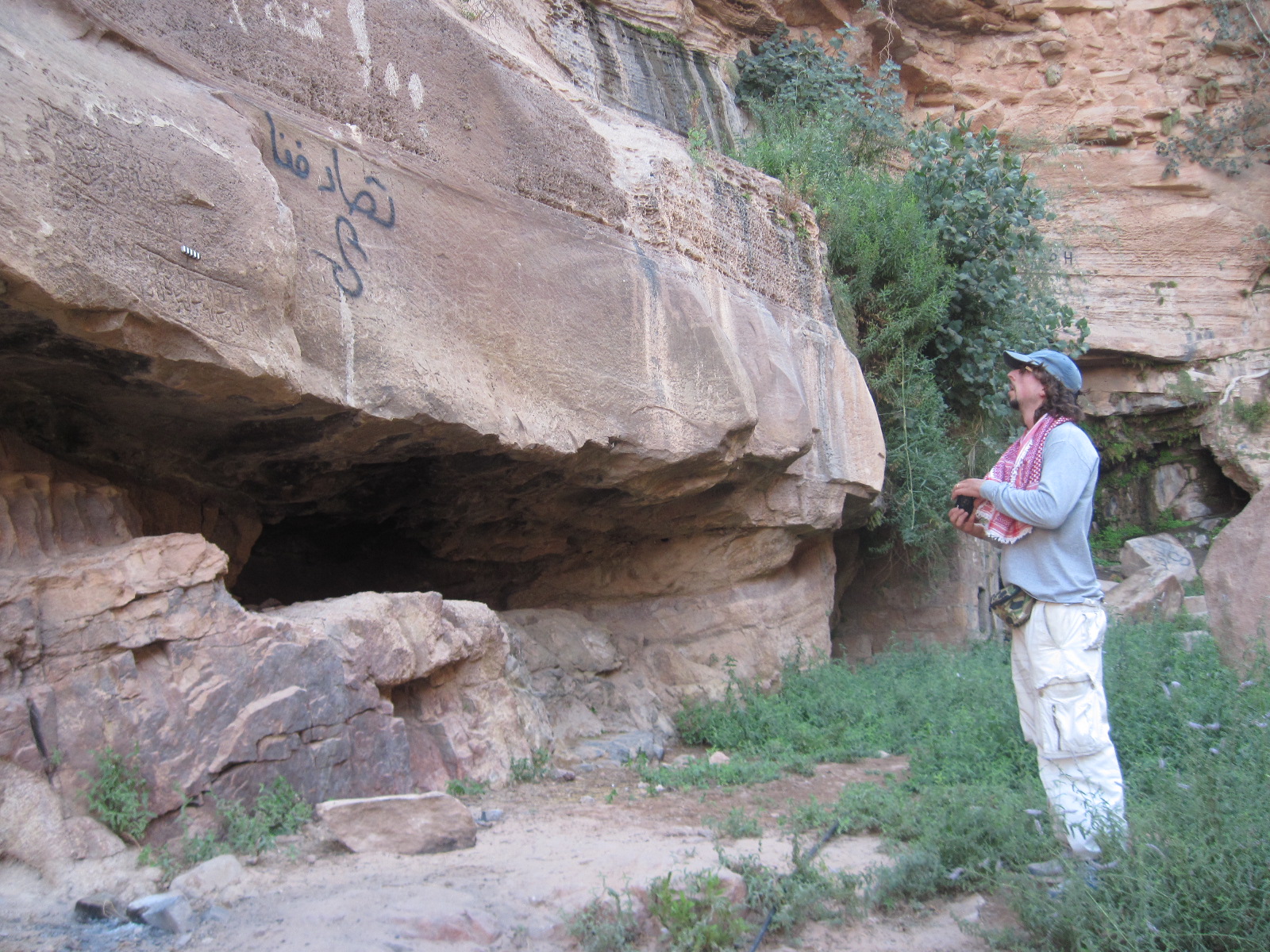
Joey Corbett at the spring with a Nabataean inscription at the far upper left

At sunset we went to a nearby site with an important rock covered with drawings and inscriptions.


Joey and Firas at the rock


A detail of the rock drawings and inscriptions

We spent the night at one of the tourist camps. The next morning Saturday August 25 we went to the Wadi Shirah north of Wadi Rum to see the Umayyad period open-air mosque there with an inscription there dated to Ramadan 107 AH/January 726 AD. Firas had written his MA thesis about the mosque and he wants to publish an article about it, so he and Joey needed to come to take some photographs. We found that the mosque had been badly vandalized recently.


Firas at the south qiblah wall of the open-air mosque


The Arabic inscription at the site dated to 107 AH/726 AD

We returned to Amman that afternoon, stopping at the Ottoman hajj fort at Wadi Hasa on the way back. The entrance was locked, so we could only walk around briefly.


The Ottoman hajj fort at Wadi Hasa


Amman July 17-August 23

On Tuesday July 17 I traveled to Amman, Jordan and moved into the American Center of Oriental Research for another three-month stay. I got a late start in the morning at 9:30 and so ended up having to take an expensive private taxi to the Allenby Bridge. After a long wait on the Israeli side, I eventually got to ACOR after six hours of travel time, one of the longest times the trip has taken.

I was back at ACOR to continue work on the final report of the Madaba Archaeological Park excavations from 1992-1993. But during the first month, I also worked on a variety of other projects. I worked further on Western Accounts of the Masjid al-Aqsa compound in Jerusalem, did some editing of the proposal to have the Baptism Site on the Jordan River nominated as a UNESCO World Heritage Site and proofread further the first of Gustaf Dalman’s volumes about Palestinian customs. I also finished my report about the survey last December of the heritage buildings in Bhimunipatnam, India.

I also did some final work on my translations of the Royal Scientific Society documents about 19th and 20th century Jerusalem for their new website and on Thursday July 26 I attended a meeting at the Royal Scientific Society about the documents – that was the first time I had been on their compound beyond the far side of the University of Jordan since 1994, when I worked for a few months at the Al al-Bayt University liaison office there.

Mohammad Ghosheh, my Palestinian colleague, also came by with a copy of his newly published, spectacular book about the Dome of the Rock.

The Muslim fasting month of Ramadan started on July 21 and ended on August 19, followed by the Muslim holiday of Id al-Fitr, so there were none of the usual public lectures or other events to attend during that time, beyond some in-house presentations by current ACOR fellows, and so I mostly stayed put at ACOR. There are better wireless internet capabilities at ACOR now, and I frittered away a good deal of time live-streaming YouTube videos in the course of the month.

Jerusalem July 1-16

I had traveled to Jerusalem to attend a conference on Jerusalem: Past, Present, and Future held at the Yad Izhak Ben-Zvi Institute. The conference put me up in the Little House in Rehavia hotel, next to the Institute. On my first morning, Sunday July 1, I went to the L.A. Mayer Museum for Islamic Art not so far away, where I had not been since the late 1990s.

The next morning Monday July 2 I went to the City of David archaeological park in Silwan for a guided tour for the conference participants given by Marva Baluka.


Marva Baluka giving the tour

Then we had a tour of the Siloam tunnel by Rony Reich. It was very valuable to understand the results of the recent archaeological work in the tunnel, especially the evidence that shows that the southwest corner of the Herodian temple compound around Robinson’s Arch was one of the last parts to be finished.


Rony Reich explaining the results of his work below Robinson’s Arch

That evening was a dinner for the conference participants and the opening session of the conference. The conference continued on Tuesday, Wednesday and Thursday July 3-5. My presentation about Christians and Muslims in Jerusalem during the Abbasid Period was on Wednesday morning.

On Friday July 6, I moved into the Albright Institute for the next ten days. During my stay I mostly worked on Western pilgrim accounts of the Masjid al-Aqsa compound in Jerusalem and on revisions to my Masjid al-Aqsa article for Humberto da Silveria’s book. I also met Khader Salameh, with whom I am cataloguing the Arabic inscriptions in the Islamic Museum, but I did not get onto the Masjid al-Aqsa compound on this trip. On Wednesday July 11 I went to the Jordanian Embassy in Tel Aviv to get an entry visa for Jordan.

Among other cultural activities, on Saturday July 14 I attended a recorder and guitar concert at the Lutheran Church of the Redeemer in the Old City and on Sunday July 15 I attended a reception and dinner at the Rockefeller Museum hosted by the Israel Antiquities Authority.