Wednesday, April 10, 2013

Bhimunipatnam February 23

The next day, Saturday February 23, was the first full day of our project. As became the usual schedule, we had breakfast at the school at 8:00 with the school students and at 8:30 the auto driver that we had hired to be with us each day, took us into the town. We first went to the town center to see the clock tower built in 1863 and renovated a few years ago.


The clock tower

We then went to Samuel’s house at 9:30 and discussed how to proceed with our project.We started our work of documentation of the heritage buildings at the mosque, ruined darghah (tomb shrine) and ashurkhanah (building for the commemoration of Muharram), along with a godown (storehouse), across the street from St. Ann’s. The local Muslims are Sunnis, but they commemorate Muharram.


Samuel, the local imam and his wife, with Ilse and me in the ashurkhanah


Ilse at the ruined darghah

At 12:00 we had lunch with the sisters at St. Ann’s and in what became the pattern for the coming days, at 1:00 I took a nap in a guest room, and then we had tea with the sisters.

At 2:00 we went to take a look at a nearby Telugu-medium school in a British building dated to 1861. The building had been renovated recently with Dutch help.


The school


A commemorative plaque at the school


The school students

At 2:30 we went back to Samuel’s place and he took us to the Chitavalsa Jute Mills several kilometers to the north. The jute mill had closed four years ago due to labor strife; our auto driver was a former employee.


The Chitavalsa Jute Mills

After we got a tour of the factory, Samuel took us to the Gosthani River near the mills and then to a picturesque vegetable market in the nearby town of Thagarapuvalasa.
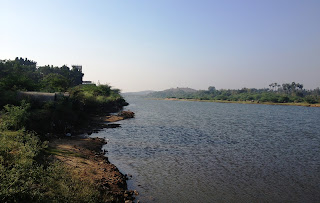

The Gosthani River near the jute mills, visible to the left

We arrived back at the school at 5:00 and we had dinner with the students at 7:30.

Saturday, April 6, 2013

Visakhapatnam and Bhimunipatnam February 21-22


The train arrived in Visakhapatnam at 6:30 am on Thursday February 21. My colleague Rani Sarma,had arranged for a taxi to take me to the Classic Guest House, where I had stayed last time. After settling in, at noon I walked along the beach to Rani’s house, about a half hour away, and we talked at length about the project. I returned to the hotel later that afternoon. My two colleagues from Bamberg, Anja and Ilse, arrived at the hotel at 7:30 after their flight from Frankfurt via Delhi. We went to a restaurant on the beach and took photographs at an elephant statue there.


Anja, Ilse and me with the elephant on the beach

 We had come to India to conduct a second season of archaeological survey and documentation in the Visakhapatnam District along the east coast of Andhra Pradesh. In December 2011, we had surveyed some early Buddhist sites and spent four days locating the heritage buildings in the town of Bhimunipatnam, some 25 kilometers north of Visakhapatnam, where the Dutch East India Company had established a trading port in the 17th century. This year we decided to focus our attention on documenting the heritage buildings in Bhimunipatnam.

The next morning, Friday February 22, we checked out of the hotel and Rani came with us to Bhimunipatnam with a hired car and driver. Rani had made the arrangements to have us stay at the recently established modern Ameya Global School some three kilometers to the north of the town. So we first went to the school at 9:45 and spoke with Tulasi, the director. Lawrence Nathaniel, a Bhimunipatnam native and now retired sea captain who is a heritage enthusiast, met us there.

At 11:00 we went with Rani and Lawrence to call on Mr. Roberts, the local historian, now elderly and in poor health. We then went to the St. Ann’s Home convent in the center of the town, where Rani had arranged with the sisters for us to have lunch each day of the project.


Lunch with the sisters

We discussed with Lawrence the need for us to have someone local with us all the time. He thought of Samuel, a school class mate of his who lives near the convent.


Samuel

He went to bring Samuel and we made arrangements and had tea with the sisters.


Tea with the sisters

Then Lawrence took us to see the house nearby where he had grown up.


The house where Lawrence had grown up

At 3:30 Rani went back to Visakhapatnam with the hired car and Lawrence took us to the school. We had dinner with the school students.


New Delhi and Hyderabad February 19-20

I arrived in New Delhi at 9:30 am on Tuesday February 19 at the start of a five-week trip to India. My arrival was the day after Varghese’s wedding in Bangalore. At the international arrivals terminal, I quickly got an India SIM card for my cell phone. That was a contrast to the major hassle it had taken on my last trip in 2011.

I had come first to Delhi to go to the American Institute of Indian Studies to meet Pradeep Mahinderatta, the vice-president. He had been extraordinarily helpful over the previous months with the bureaucratic arrangements for my up-coming project. I first went to the AIIS office in Delhi, only to learn that shortly before I arrived, he had gone to the AIIS Center for Art and Archaeology in Gurgaon, south of the city. His secretary kindly arranged to have a taxi take me there. I met Pradeep and the director Vandana Sinha and browsed a bit in the library.

The taxi driver then took me to my hotel near the airport, which I had booked over the internet. It took an extraordinarily long time to find the hotel, because, as I have experienced before in India, the location of the hotel as shown on Google Maps was way off and my driver kept trying to get me to go other hotels where he could get a kick-back for taking me there.

The next day I got up early for my flight to Hyderabad, Stupidly I went first to the domestic terminal, quite a distance from the international terminal, which Air India uses for all flights. The departure of my flight was delayed by fog, and I arrived in Hyderabad at 10:30 am.

At the Hyderabad airport I contacted Shobha, my friend and colleague from my days at the Henry Martyn Institute, and we agreed to meet at the City Centre Mall. It took me a while to get there and upon arrival I discovered that my cell phone no longer worked. So to contact her, I had to walk around until I found a pay phone, which are no longer very common since everybody has cell phones, and I had to call repeatedly until I was finally able to connect to her. So after wasting an hour and half, we finally met in a coffee shop in the mall at 2:15.

Once we met, I learned more about today’s comedy of errors. I had gone to the coffee shop when I first reached the mall, but stupidly failed to see her sitting there waiting for me to show up. My calls from the nearby pay phone failed to reach her, because her cell phone did not work inside the multi-storey mall, and only when she had given up waiting and returned home did we connect. Anyway, we had a pleasant chat.

I then went to see my friend Timothy Marthand, the concert pianist, to pick up the fancy digital camera that he had for me. Our meeting had to be very brief and in my haste I failed to notice that the camera lens was not in the box with the camera body and other accessories, but rather was on the table next to us. So in my third case of stupidity for the day, I left without the lens. That thwarted my hopes to have the use of this fancy camera during the following weeks.

After meeting Timothy, I went to the Secunderabad train station for my 8:30 overnight train to Visakhapatnam.

Erlangen and Bamberg February 13-18

I traveled to Germany to attend a conference at the University of Erlangen, organized by my colleague Ute Verstegen, the professor for early Christian archaeology. My flight from Istanbul on Wednesday February 13 arrived in Munich at 12:30 and I took a train to Erlangen.

I had come a day early, so I had the next day of Thursday February 14 available to spend in the University of Erlangen library, proofreading the indexes to the Gustaf Dalman volumes that I had just received. That evening I attended the opening session of the conference about Shared Memory. Parallel use of religious sites in interreligious and interdenominational contexts. The opening lecture was followed by a reception. Later I went to a local restaurant with some of the conference participants.

The next day, Friday February 15 I attended the full day of the conference. My presentation about Shared Use of Religious Sites in India was in the afternoon. I spoke about three examples in India.

First, the Basilica of Our Lady of Health in Velanganni, Tamil Nadu, a major Roman Catholic pilgrimage shrine that many Hindus come to, which I had visited in December 2011without fully realizing how interesting the place is.


Some people, apparently Hindus, bringing their offerings of coconuts to Our Lady of Health in Velanganni.

Second, the Baba Budhan Giri shrine in Kerala, a shared Muslim-Hindu shrine for centuries that aggressive Hindu nationalists have been trying to take over in recent years; I knew about this from two articles by Yoginder Sikand in the Journal of the Henry Martyn Institute that I had edited back in the day.


A photo off the internet of Indian government security personnel keeping the peace at the Baba Budhan Giri shrine.

Third, the case of Sai Baba of Shirdi, the god-man who attracted Hindu and Muslim followers before he died in 1918, but whose shrine in Shirdi, Maharashtra, which I have visited, is now totally Hindu.

An historic photo off the internet of Sai Baba of Shirdi at the “mosque” where he lived.

I joined the conference participants that evening for a restaurant meal.

The next morning, Saturday February 16 I took the half-hour train trip to Bamberg and spent the bulk of the day and the next checking the Dalman indexes. On Sunday I met my two colleagues Anja and Ilse at a restaurant to talk about our up-coming India project. That evening I went to see the movie Lincoln, dubbed in German.

Monday February 18 I also spent on the University of Bamberg campus, where I met my colleague Klaus. That afternoon I took the train to the Frankfurt airport in plenty of time for my 9:30 flight to New Delhi. At the airport people were protesting for a ban on night flights to cut down on noise.


The protesters at the Frankfurt airport

Istanbul February 11-12

Monday morning February 11 I traveled to Istanbul. I was on my way to Germany to attend a conference but found that I could stop over in Istanbul for a couple of days without adding to the cost of my airline ticket. I took a Pegasus Airlines flight, which arrived at the Sabiha Gökçen Airport to the east of the city at 7:30 am. I took a bus to the Taksim central bus station and then walked around for a few hours before checking into my hotel in the Sultanahmet area; I walked around further later that afternoon.

The next day Tuesday February 12 I did further site-seeing of places I had not been to last March when I was in Istanbul for a short time. In the morning I took a ferry from Eminönü across the Bosphorus to Kadikoy. I then walked around and took the M4 metro line to the Kartal end station and back to Kadikoy, which was not interesting because it was all underground. I took another ferry back across the Bosphorus to Besiktas, arriving at noon. I went to the mid-19th century Dolmabahçe Palace and took the tour of the Selamlik part of the palace. I had taken the tour of the Haramlik part of the palace last March.


The Dolmabahçe Palace from the ferry

I then returned to the Sultanahmet area and went to the Mosaics Museum, which had been closed for renovations last March. I saw the exquisite mosaics of the Byzantine Great Palace in place there.


The mosaics of the Great Palace

In the morning of Wednesday February 13 I took the ferry to Kadikoy and from there a bus to the Sabiha Gökçen Airport, which took an hour and a half of travel time. I arrived in plenty of time for my flight to Munich that left at 11:15.

Jerusalem February 6-10

On Wednesday February 6 I went to Jerusalem to attend a seminar. I had seen in the newspaper the previous day that the Allenby Bridge would only open in the afternoon, so I left ACOR at noon. I arrived in Jerusalem at 4:00 (5:00 Jordan time) and checked into my hotel on Salah al-Din Street.

Thursday and Friday February 7-8 were the two days of the seminar on Recent Advances in Islamic Archaeology sponsored by the Albright Institute, but held at the Ecole Biblique. I had originally intended to give a presentation about Christians in Jordan in the Early Islamic Period, but I had withdrawn when it looked like my schedule would not permit me to attend. But as things turned out, I was able to come, although it was not possible to get back on the program. Unfortunately, a number of the Palestinian speakers were unable to come. The first day I spoke with my colleague Khader Salameh during the lunch break and then participated in the round-table discussion.

On Thursday February 7 I received an invitation to the wedding of Varghese, my former student and colleague at the Henry Martyn Institute in Hyderabad. The wedding was scheduled at short notice for Monday February 18 in Bangalore. I was sorely tempted to rearrange my travel plans to be able to attend, but in the end it was just too complicated to do so.

On Friday I shifted from my hotel to the Kenyon Institute, where the next day, Saturday February 9, I participated in a one-day conference about Ottoman Palestine, organized by Micaela Sinibaldi. I gave a presentation about Every-Day Life in the Masjid al-Aqsa Compound in the Ottoman Period, a shortened version of the talk I had given at ACOR a couple of weeks earlier.


Micaela Sinibaldi introducing my lecture

On Sunday February 10, I participated in the tours organized as part of the Ottoman conference. In the morning I joined the tour for the conference speakers of the Masjid al-Aqsa compound led by Yusuf al-Natsheh, from the Awqaf Administration’s Department of Archaeology. We went to the Dome of the Rock, Solomon’s Stables, the old al-Aqsa (Double Gate passage) below the al-Aqsa Mosque, the al-Aqsa Mosque and the manuscript conservation laboratory in the Ashrafiyah Madrasah, before going to Yusuf’s nearby office. In recent years I have had a permit that enabled me come onto the compound to work in the library, but that did not allow me to go into the various other buildings, which have been closed to non-Muslims without special permission since 2000, so today’s trip was a great opportunity. I had not been into Solomon’s Stables since 1999 or the Old al-Aqsa since the mid-1990s before the renovations.


Yusuf showing the group around the Old al-Aqsa


The group near the Dome of the Rock


One of the staff speaking about the manuscript conservation laboratory

We then went to the Citadel for the tour at 11:15 given by Mahmud Hawari.


The group at the Citadel

Then at 1:30 I started my own tour of the Islamic buildings in the Old City. At 2:00 we reached the Abu Shukri restaurant where we had lunch and at 2:45 we resumed my tour around the Old City and especially through the rarely visited neighborhoods in the northeast part of the Old City, ending up at Herod’s Gate at 5:00.


Me leading the tour of the Old City with the 14th-century Tankiziyah Madrasah in the background

That evening I took a Nesher sherut taxi to Ben Gurion Airport, arriving at 10:00, and I hung out until my flight to Istanbul left at 5:20 the next morning; I was able to get a lot of internet time in as I waited.

Friday, April 5, 2013

Amman January 1-February 5

In January I continued to stay at the American Center of Oriental Research to work on my various research projects.

I spent a lot of time working on the index for the first two volumes of Gustaf Dalman’s study of Palestinian customs, finally finishing it at the end of January. That brought to an end a full six-months of work on the Dalman translation that I had put in since late 2010.

In January I also worked on the application to have the Baptism Site accepted on the list of UNESCO world heritage sites, translated more of Mohammad Ghosheh’s book about the Dome of the Rock and put some final touches on my reports about the Humayma excavations.

On Monday January 7 I attended a reception for the ACOR trustees. Prince Raad ibn Zaid attended and I showed him the photograph of him from 1965 in Mohammad Ghosheh’s Dhakirat al-Quds volumes of historic photographs of Jerusalem that I am translating into English.


Prince Raad and his wife Princess Majda looking at his photograph from 1965

The second week of January was an interesting time for weather. It started off with two days of heavy rains that disrupted most everything, not least traffic due to exceptional flooding of the streets. Then the snow started falling early Wednesday January 9, which also immediately cut off the internet for much of the country. The snowfall continued for two days, although the total amount of snow accumulation was not exceptional. Things started to recover on Friday and the internet places near the University were open. Wireless internet connections came back on Saturday, but we at ACOR could not connect to any websites other than Google ones, like Gmail and Google Earth, and Skype. The problem was especially acute for ACOR’s service provider and only after six and a half days did ACOR’s internet finally start to work again.


The ACOR snowmen

On Sunday January 21 I joined a trip to Umm al-Jimal. The US ambassador came to see the results of the recently completed consolidation of some of the buildings there by Bert de Vries and his team that had been financed by the embassy’s Ambassador’s Fund.


The Umm al-Jimal team with the US ambassador

On the evening of Thursday January 24 I went on a trip to Ghor al-Safi. Dino Politis, the director of the excavations there, had come to Amman and I went back with him, accompanied by Micaela Sinibaldi from ACOR. It had been a while since I had seen the results of the on-going excavations, so the next day, Friday, I got a tour of the Shaykh ‘Isa settlement site and the Tawahin Mamluk-period sugar mills and on Saturday morning I got a tour of the recently opened museum. Later that morning Micaela and I took a bus back to Amman.


Dino in the Ghor al-Safi Museum


The Mamluk Sugar Mills in Ghor al-Safi

On Tuesday January 29 I gave a public lecture at ACOR about Daily Life on the Masjid al-Aqsa Compound in the Ottoman Period, in which I spoke about the things that residents and pilgrims do, the people who work on the compound, proper etiquette and non-Muslims on the compound.