Thursday, July 1, 2010

Amman June 1-30

I spent the month of June at the American Center of Oriental Research in Amman, Jordan, now half-way through my six-month fellowship to work on the report of the archaeological excavations of the Byzantine-Umayyad Burnt Palace in the archaeological park in Madaba.

Among my other research activities, early in the month, while John Oleson, the director of the Humayma excavations, was around, I continued to work on my Humayma excavation reports. I also translated a short article of my Palestinian colleague Khader Salameh about the Armenians in 19th Century Jerusalem. I also evaluated the MA thesis of student at Adelaide University in Australia about Byzantine mosaics in Jordan.

June was a busy month at ACOR, with a lot of people on various excavation projects passing through. In the middle of the month a group of American students arrived for a two-month Arabic language program, so the building has been full to capacity.

I also went on a number of trips to visit archaeological sites. In early June the ACOR trustees were around and on Friday June 4 I joined them on a day trip to Umm al-Jimal in northern Jordan, where I spoke about the churches I had excavated there during the 1984 season.

The North Double Church at Umm al-Jimal

We then went to the nearby site of Umm al-Surab and then to a winery at Jabr, near the border with Syria. We hung out at the swimming pool at the residence of the vineyard proprietor, who also held a wine-tasting session.

The group at the pool
I went on a number of day trips to visit archaeological sites with Ivana Kvetanova, an ACOR fellow from Slovakia. On Friday June 11 we went to visit sites in the north Kerak plateau and south of Amman. We went to the Ottoman hajj fort at Qatrana, the Roman legionary fortress of al-Lajjun, where I had participated in the excavations for five seasons during the 1980s, Ja‘dat al-Jabur, where I had worked in 1996, and other sites where there are remains of Byzantine period churches, including Hesban.

The Byzantine church at Hesban

Then on Thursday June 24 we visited Byzantine church sites in the Madaba area: Ma‘in, ‘Uyun Musa, where I had worked in 1987, Mukhayyat, Khattabiyah and ‘Umayri East, before going to ‘Iraq al-Amir. The next day, Friday June 24, we went to Mount Nebo to meet with Carmelo Pappalardo, the head of the Franciscan archaeological mission there.

Ivana at Iraq al-Amir

Also on Saturday June 19 I went with Tom Parker, the director of the al-Lajjun excavations, and Stephanie Brown, a graduate student, to visit sites south of Amman. We went to the site of Massuh, where I had not been before, as well as Hesban, Tell ‘Umayri and the newly discovered church at ‘Umayri East, and Khirbat al-Sar.

Among other activities, on June 7 I led a tour of the main King Abdullah mosque in the city center for the members of a dig team from the US. On June 9 I went to the Columbia University Center for a showing of the movie Hurt Locker. The showing was outdoors, but it was cool enough to be unpleasant; many of the audience left early on. I also attended the usual round of public lectures at ACOR and a reception at the German archaeological institute.

I continue to watch a lot of German-language video podcasts. This month I watched a 14-part lecture series about cultural anthropology posted on the University of Munich’s iTunes University site.

Monday, June 21, 2010

Amman, April 29-May 31

After my return from my trip to the UK at the end of April I spent the month of May at the American Center of Oriental Research in Amman, Jordan. As my main activity, I continued to work on the report of the archaeological excavations in 1992-1993 in the area of the Byzantine-Umayyad-period Burnt Palace in the archaeological park in Madaba. On May 4 I went with Ghazi Bisheh, the excavator, to Madaba to see the archaeological park.

Ghazi Bisheh in front of the shelter over the Burnt Palace mosaics

During the month Emma Morse helped out with the project a few hours a week as a volunteer. She was an American college student studying Arabic at the University of Jordan.

On May 12 I returned to Madaba to give a talk in Arabic about the destruction of images in the mosaic floors of the region to the students of the Institute for Mosaic Art and Restoration in Madaba.

In early May I spent a few days working on the report of my excavations last summer at Jurash in Saudi Arabia. Then in the second half of May, when John Oleson, the director of the Humayma excavations. was around at ACOR. I worked on my Humayma excavation reports, incorporating information from my short excavation project there last spring into the drafts of the reports for my work there in the 1990s.

On May 23-24 I went with John Oleson and Ivana Kvetanova, a fellow at ACOR from Slovakia, on a trip to visit the current excavations at Humayma. While at the site, Ivana helped me take absolute elevations of one of the churches I had worked on last spring.

Ivana helping with the surveying at Humayma

After visiting the site, we continued on to Aqaba, where we spent the night; later that afternoon I walked around the archaeological sites in Aqaba with Ivana. The next morning May 24 we went back to Humayma, stopping at the small Roman fort of Khirbat el-Khalde on the way. At Humayma I showed Ivana around the site and that afternoon we returned to ACOR.

John Oleson pointing out a barely visible water channel at Khirbat el-Khalde

One person who passed through ACOR in early May was Dino Politis, the director of the excavations in Ghor al-Safi, whom I had just met in London. He came with some colleagues from the European Center of Byzantine and Post-Byzantine Monuments in Thessaloniki.

Another visitor was Helen Evans from the Metropolitan Museum of Art in New York, who came to make arrangements for getting some objects on loan for an exhibit about Byzantium and Early Islam in 2012. On May 27, I joined her and a group from ACOR for a day trip to Qasr Hallabat and Hammam al-Sarah, where we got a tour from Ignacio Arce, who has been working at the sites in recent years and setting up a site museum.

The group at Qasr Hallabat

Ignacio Arce speaking about the site

Then on May 29, I joined Helen Evans and Ben Anderson, a researcher currently at ACOR, on another day trip south of Amman to the Byzantine and Early Islamic sites of Umm al-Rasas, Lehun, Nitl and Umm al-Walid.

Helen and Ben at the Umayyad palace at Umm al-Walid

In the course of the month I also attended the usual round of public lectures at ACOR, the German and British archaeological institutes and the new Columbia University Center for Middle Eastern Studies; I also attended a couple of dance performances at the Husein Cultural Center.

Thursday, April 29, 2010

Oxford and London April 22-28

At the end of April I traveled to the UK to attend a conference at Oxford University. There had been considerable uncertainty about whether I would be able to travel or whether the conference would have to be rescheduled due to the disruptions in airline travel caused by the eruption of the volcano in Iceland. But as it happened I was able to fly as scheduled on the morning of Thursday April 22 on the first BMI flight from Amman to Heathrow since the start of the Iceland volcano problem. The flight was uneventful and there were even a few empty seats on the plane.

I arrived in Heathrow in the early afternoon and spent that night in a hotel near the airport. The next morning, Friday April 23, I took a bus to Oxford and got settled into my room in Keble College.

Keble College. My room was towards the left.
That afternoon I went to the Ashmolean Museum and later met Nisha Keshwani, currently a graduate student in cultural anthropology at Oxford University. She had been a student at the Henry Martyn Institute in Hyderabad during the 2006-2007 academic year. That was just after I had left, so I had not met her before. That evening I met the conference participants in a local pub.
Nisha Keshwani and me
Saturday April 24 was the one-day conference on religious conversion in Late Antiquity, sponsored by the Oxford Centre for Late Antiquity. I gave my presentation about “A Christian City with a Major Muslim Shrine: Jerusalem in the Umayyad Period”. After the conference we all went to a Lebanese restaurant for dinner.

The following day, Sunday April 25, I went to the Natural History and Pitt Rivers Museums in the morning and then met Konstantin Klein, a graduate student at Oxford who is studying Jerusalem in the Fifth Century; I had first met him in 2007 when he was a student at the University of Bamberg. Later that afternoon David Singh picked me up and took me to his home in a neighboring town, where I met his wife and daughter. David, who is now employed at the Oxford Centre for Mission Studies, was a former faculty member at the Henry Martyn Institute.


David Singh and his wife
On the morning of Monday, April 26 I took a bus from Oxford to London and checked into a hotel near Paddington Station. In the afternoon, I went to the Science Museum, the Natural History Museum and the Victoria and Albert Museum, all in just over three hours. That was my most spectacular achievement in museum visiting since 2001, when I managed to see five museums in Munich within three hours. In the evening I met Rebecca Foote for dinner at an Indian restaurant near Euston Square. Rebecca has been a member of the Humayma excavations over the years, focusing her attention on the Abbasid family palace, and she is currently in London working to produce some of the volumes of the Khalili collection of Islamic art.

The next day, Tuesday April 27, I met Dino Politis, of Lot’s Cave excavation fame, at the British Museum; I had last been there in the mid-1990s. He showed me around the museum, before we went to the office of the Palestine Exploration Fund, where I browsed in the library for a while. That afternoon I went to the Institute of Ismaili Studies, near the University of London, to meet some Indian Ismaili students from the ITREB Centre in Mumbai who had been students of mine in a three-week program in 2005 at the Henry Martyn Institute. After attending a lecture at the Institute, I met four of the students, who are currently in graduate programs at the Institute and the University of London Institute of Education.
The Ismaili students and me
On Wednesday April 28, in the morning I walked around Hyde Park and St. James Park, before heading to Heathrow for my afternoon flight back to Amman. During my stay in the UK, most of the days had beautiful sunny weather, continuing my track record of only rarely experiencing rain during my stays in the UK.

Flowers in St James Park

Amman April 1-21

I spent the first part of April in Amman, continuing my fellowship at the American Center of Oriental Research (ACOR) to help Ghazi Bisheh write the final report of his excavations in 1993-1994 at the Burnt Palace in Madaba.

Things were looking up for the project this month. Ghazi was able to locate his monthly and quarterly reports, and I found some additional records, so we have enough information now to produce the report. We also retrieved the pottery from the project from the Department of Antiquities storerooms. Emma Morse, an American studying Arabic at the University of Jordan, also started helping out as a volunteer for a few hours each week.

My Palestinian Customs book was published by the University of Jordan Press in early April, only a couple of weeks after I had submitted the final camera-ready copy. I got my author’s copies on April 6, although copies are not yet available for sale.

The cover of my Palestinian Customs book

I also worked on my article about Jerusalem in the Umayyad period for the upcoming conference at Oxford University on religious conversion in Late Antiquity and I polished my translation of a 19th-century German article about Jerusalem.

On April 5 I went with Chris Tuttle, the Associate Director of ACOR, Tali Ginni, from the Israeli Antiquities Authority, and Ben Anderson, currently a fellow at ACOR, on a day trip to Petra. We went see to the Petra Church and then spend a long time at the Temple of the Winged Lions, before having lunch with the German excavation team currently in Petra. Later in the afternoon we dropped Tali off at the Aqaba-Eilat border crossing, before returning to ACOR later that night. That was the first time I had been to Petra since 2004.

Chris and Tali at the Temple of the Winged Lions

Among other scholarly activities, on April 8 I met Raouf Abujaber in his downtown office. He is interested in the Ottoman period history of Jordan and I presented him with a copy of my Palestinian Customs book. On April 14 I attended a lecture at ACOR by Franklin Price about nautical archaeology, which was followed by a reception and on April 18 I attended the lecture at the Columbia Center by Hazem Malhas on the environment; he is the newly appointed Minister of the Environment. On April 21 I attended the all-day Science Day archaeology conference at the University of Jordan.

On Friday April 16 I went to Jerash with Ivana Kvetanova, an ACOR fellow from Slovakia who is interested in early Christianity. We walked all around, especially seeing all the Byzantine churches, including the Church of Peter and Paul in the east part of the city, which I had not seen before.

Amoing other activities, on April 7 I invited Mira D’Souza for lunch at ACOR. She is an undergraduate at Drexel University currently studying Arabic at the University of Jordan. Mira is the daughter of Andreas and Diane D’Souza, the former directors of the Henry Martyn Institute in Hyderabad, where I worked between 2000 and 2006. I met Mira again on April 12 for the flamenco dance performance by Rocio Molina. On April 10 I went to see the recently-released Pakistani movie with a serious theme, Khuda Ki Liye (For the Sake of God) at the Royal Cultural Centre.

Tuesday, April 6, 2010

Amman March 1-31

I spent the month of March in Amman, at the start of my six-month fellowship at the American Center of Oriental Research (ACOR).

I am here to help a Jordanian archaeologist, Ghazi Bisheh, write the final report of his excavations in 1993-1994 at the Burnt Palace in Madaba. His year-long excavation of a Byzantine and Early Islamic period palatial building was an ACOR-US Agency for International Development project to promote the tourist development of Madaba, but regrettably almost nothing was ever published about the excavations. I am the first recipient of ACOR’s new publications fellowship, intended to support publication of old excavation projects, especially ACOR-sponsored ones.

So I spent a number of days sorting through files of the project at ACOR, and searching for things stored in various nooks and crannies of ACOR that I had not been in before. Unfortunately, Ghazi has not able to locate his field notes, plans and summary reports, although he had not yet looked everywhere in his home. We did, however, locate the pottery from his excavation. Ghazi and I went out one day to the Department of Antiquities storeroom to identify the several crates of pottery in storage there, but we need to receive formal permission from the Department to bring the pottery to ACOR. Samer Shraideh, the person who had inked all of the drawings for the project, came to ACOR one day to go over his materials with me. Tom Dailey, the USAID person back in the early 1990s, also happened to pass through ACOR for a couple of days.

Ghazi sorting through the pottery in the storeroom

In the meantime I translated into English an article in Italian that the Franciscan archaeologist Michele Piccirillo had written about his own excavations at the Burnt Palace.

With work on the Madaba Burnt Palace publication temporarily stymied, I was able to work on other projects. I finished the final proofreading and indexing of my Palestinian Customs book that the Bilad al-Sham History Committee of the University of Jordan will be publishing; Dr. Adnan Bakhit heads the committee. I submitted the final camera-ready copy on March 22. I also started writing my article about the Islamization of Jerusalem in the early Islamic period for presentation at a conference at Oxford University at the end of April. I did another round of editing of Khader’s long article about the renovations of the Ottoman sultan Mahmud II in Jerusalem in the early 19th century, before sending it back to him for further comment and I also proofread the upcoming issue of Near Eastern Archaeology.

I also did some English editing of articles for the University of Jordan’s Jordan Journal for History and Archaeology, which Dr. Bakhit edits. I was scarcely in the country for 24 hours before he called me up to do the editing – mostly of the English abstracts for articles in Arabic. This time around I have an official letter from the university president authorizing me a payment of 1 dinar ($1.40) per page that I copyedit.

On Monday March 16 I gave a public lecture at ACOR about Muslim pilgrims to Jerusalem in the Ottoman Period, followed by a reception. My presentation, which focused on the pilgrimage account of two Moroccan pilgrims from the late 18th and early 20th centuries was well received. I also attended a number of lectures given by fellows at ACOR and at the Friends of Archaeology Society.

Dino Politis was in the country with a small group to work on the pottery from his recent excavations in Ghor al-Safi. I was able to chat with him in Amman, as well as his colleague Chris Entwhistle from the British Museum, whom I had last met when I was working with Dino at the Lot’s Cave excavations in 1994. Another person who passed through ACOR with a group of students was Warren Schultz, who was in graduate school at the University of Chicago when I was there. At the end of the month Tali Gini, who works in the Negev for the Israel Antiquities Authority, came to ACOR for some ten days to sort through records from the Temple of the Winged Lions in Petra, and I had plenty of occasions to chat with her.

On Sunday March 14 I went with a group of ACOR fellows to Yarmouk University in Irbid to attend a reception introducing new faculty members in the Faculty of Archaeology and Anthropology. Afterwards we got a tour of their laboratories.

On Friday March 19 Ghazi and I were invited by Othman and Enaya Malhas to their home in Anjara, near Ajlun for a lunch gathering. Othman is a retired mathematics professor who is building a conference center in one part of his country estate. Othman is a fan of the Roman mathematician Nicomachus of Gerasa (modern-day Jerash). Most of the other guests were members of the extended family, including Hazem Malhas, whom I have met on and off over the years, including once in Hyderabad. Hazem recently became the minister for the environment.

On Friday March 26 I went to Madaba for the day. I had been in Madaba a year ago with some people from the Albright Institute, but it had been some years since I had walked around the city to see all of the scattered antiquities. It being Friday, the specific area of the Burnt Palace was closed, but I could see it from a distance.

The Shelter over the Burnt Palace

Tuesday, March 2, 2010

Bamberg February 1-28

I spent the month of February in Bamberg. The weather stayed cold and snowy until the last week, so I had little motivation to go anywhere on weekends.

The winter semester at the university wound down in the first half of the month. On Saturday February I held the last three class periods of my history and archaeology course as a block seminar.

Me with the students

February was a good month for work on the sites and monuments of Jerusalem project. Hanswulf Bloedhorn came from Tübingen on February 23 to discuss progress with Klaus and me; we still have a lot of work to do, so I will return to Bamberg in the fall.

I also worked on my article for Fred Donner’s festschrift and worked on editing an article by my Palestinian colleague Khader Salameh and wrote a short article about Jerusalem for the Arab Thought Forum, based on my presentation last year.

On Monday February 22, I joined the field trip of Islamic art students to the Linden Museum in Stuttgart, where we spent the full day seeing the museum’s collection of Islamic art and ethnographic items. We received a thorough tour, including the storerooms and then got to examine some of the metal objects close up.

The group examining metal objects in the Linden Museum

One lecture at the university that I attended was by Haim Goren on Germans in Palestine in the 19th century.

The last Volkshochschule French class for the semester was on Tuesday February 2; afterwards I joined the group for a restaurant meal.

Me and the French students. The instructor is at the head of the table.

Tuesday February 16 was Carnival, marked by a parade through the city center. It seems that having a parade is only a very recent development in Bamberg.

The carnival parade

The last week of February I wound things down. I put two suitcases back in storage in Klaus’ office, made final arrangements with my landlady and left Bamberg at noon on Sunday, February 28 for the Frankfurt airport for my flight that evening to Jordan.

I took a train that was scheduled to get me to the airport four and a half hours ahead of time. That turned out to be a good idea, due to the hurricane force winds that day that led to major disruptions all across Europe. My train was stopped at Hanau, near Frankfurt, due to the winds, but I was able to take a subway to the airport without much of a delay. At the Frankfurt airport, almost all flights to European destinations were being cancelled. My flight to Jordan and other long distance flights were not affected, but there was a huge hour and a half long line at the check-in counters for Lufthansa.

My flight ended up leaving on time. But there were remarkably few passengers on board. Only about a third of the seats were occupied, so I was able to stretch out over three seats and get some sleep on the flight of about three and a half hours.

Wednesday, February 17, 2010

Bamberg January 6-31

I was back in Bamberg by the early afternoon of Wednesday January 6 after a routine flight from Mumbai to Frankfurt.

I continued to work on the sites and monuments of Jerusalem project. Hanswulf came from Tübingen on Monday and Tuesday January 18 and 19 to discuss progress.

I also had further class periods of my History and Archaeology of Bilad al-Sham from Justinian to Harun al-Rashid. One of the students had a scheduling conflict for the scheduled class time on Fridays, so on Saturday January 9, we had three class periods one after the other as a block seminar.

I also started work on a new article for the upcoming festschrift of Fred Donner, my PhD supervisor at the University of Chicago.

The weather was cold and snowy. The temperatures rose above freezing for only a couple of days the entire month. The snow on the ground was no obstacle for some bicyclists.

Bicyclists in the snow

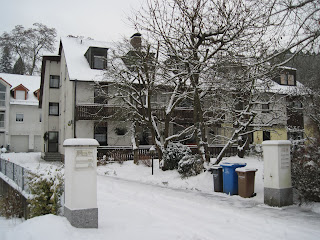
My apartment building

The art history mural near my apartment

Most weekends I stayed in Bamberg. The one trip I made was to attend a conference in Berlin on Islamic art museums. On Wednesday January 13 I traveled to Berlin by train with Ilse and Anja, and another student, arriving in time for the opening lecture in the Mshatta Hall of the Pergamon Museum by Oleg Grabar, followed by a reception. On Thursday January 14 I attended the conference sessions in the Pergamon Museum and during the lunch break I toured the museum, taking some photographs of the famous façade from the Umayyad period palace of Mshatta in Jordan.

The Mshatta Facade

On Friday January 15 I attended the morning session of the conference and then in the afternoon went to the newly re-opened Neues Museum, which houses the Egyptology collection. The conference was held as part of the process of planning for the new design of the Islamic Art collection and the rest of the Pergamon Museum. The renovation of the building has gotten underway, in the latest phase of the decades-long renovations of the various museums in Berlin’s Museum Island.

The Pergamon Museum under renovation

I then went to the train station in time for a 4:20 departure back to Bamberg. Unfortunately, the unusually cold weather had been causing problems with the train service. My train was delayed and after making some alternative connections, I finally got to Leipzig at 7:45. By then it was too late to catch the last regional train to Bamberg of the day with my cheap ticket, so I had to take an expensive intercity express, which itself left an hour and a half late. So I finally got back to my apartment at 1:15 am.

Among other complications, on the evening of Tuesday January 26 the transformer unit on the power cord of my lap-top computer shorted out. That blew the fuse in my apartment, leaving half of my apartment without power until the next day. I could not find a replacement cord anywhere in Bamberg, so I had to order it over the internet, which took a few days to arrive. I was able to use my desk-top Apple computer, however.

Over the past months I have had wireless internet access in my apartment using a wireless account of some neighbor that was not password protected. On January 28 I called up Zovi in Shillong on her birthday using Skype over that connection. But on Friday January 29 that neighbor put a password on the account, which meant that I no longer had internet access at home. That was not a major problem, because I can use the wireless internet at the university and in fact it was sometime of a blessing in disguise, since I have tended to waste too much time browsing the internet in my apartment.

Among other things, I also bought a new digital camera; my old camera had malfunctioned at the start of my India trip, so I had to use the lower quality camera on my iPhone for my India photographs. My French class on Tuesday evenings continued. I also went to see the movie Avatar in 3-D and on Sunday January 24 I attended an Irish step dance session for a last time on this stay in Bamberg. When Hanswulf came, he brought the German comedian Loriot to my attention; his humorous segments from decades past can be found on Youtube.