Saturday, January 7, 2012

Raju’s Farm December 19

On Monday December 19 we began the day with Raju giving us a tour of his farm. His farm is located in an isolated valley surrounded by hills. There are no other buildings in sight. He is investing a great deal in developing the property with advanced agricultural techniques. He recently built a guest house where we stayed. He has a deer there temporarily.
 

The guest house


The deer


The gazebo for meals


The view from the guest house

Raju was very hospitable, and we had extended conversations over dinner in the evenings.

After saying our goodbyes, we traveled south to Gopalipatnam to see some early Buddhist rock shelters near an active Hindu temple. We were shown around by a local guide.


One of the rock shelters


Our guide standing next to an inscription

We then saw the meager remains of a Dutch fort in the village. Little beyond one wall remains.


The wall of the Dutch fort

We were a major attraction for some school children on a field trip.


The school children

We also went to the nearby beach at Pentakota and Ilse and Anja drew a plan of a British bungalow there.


The British bungalow

At the beach we met up with the school children, who were scared to get too close to the water.
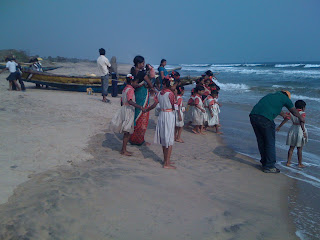

The school children at the water's edge

Also at the beach were many fishermen and their womenfolk waiting for them to land with the day's catch.


The village women


Fishermen hauling their boat ashore

Afterwards we continued to the city of Tuni, just across the border of the East Godavari District to get newspapers with news about yesterday’s event. There would have been a news item about us on the television news broadcasts last night, but we did not have the opportunity to see it.


The two newspaper articles about yesterday’s visit to the Buddhist sites at Kummari Lova.

We then returned to Visakhapatnam. We dropped Venkatesh off at the bus station and checked into the Classic Hotel.

Raju’s Farm December 18

On Sunday December 18 we went on a trip south to the East Godavari District to see a cluster of newly discovered early Buddhist sites at Kummari Lova. Rani’s sister and nephew came along with K. Suryanarayana, the Andhra University professor, and we were joined by a number of local press reporters. We toured three of the early Buddhist sites that a local school teacher had first noticed a couple of months ago. 
 

The first site


Me being interviewed at the second site (the school teacher is on my left)

Some bricks at the third site being exposed in a farmer’s field

We then went to the nearby village where we were shown some pottery found at the site.


The pottery

In the afternoon we proceded to the nearby village of Vempadu, where we visited Chitrapur, a retired forestry official, at his home. We were joined there by C. V. Raju and stayed for lunch and a long chat.


The group at Chitrapur’s house

The women servants got all dressed up specially for a photograph.


The ladies in the group

Afterwards we went to the beach nearby. Ilse and Anja briefly went into the water. There is a strong undercurrent, so it is not safe to venture out very far. We had a discussion at the beach about the prospects for a project next year.


The beach


The group at the beach

Ilse and Anja in the water

Then at sunset, while Rani and the others returned to Visakhapatnam, Ilse, Anja, Venkatesh and I returned to Raju’s farm.

Raju’s Farm December 17

On Saturday December 17 we first went to the nearby train station to pick up Rani who had come from Visakhapatnam to spend the day with us. We went to Peda Uppalam, where we walked around the site in general. 
 

Venkatesh and me exploring the site


The group at the Buddha statue

We finished up what we wanted to do at the site by lunch time.


Lunch

In the afternoon we met Raju who took us to his nearby home village of Gudivada. He took us to a hill in the village where there is an early Buddhist site, apparently undocumented. As with other sites, there was little visible on the surface beyond some scattered brick fragments.


The early Buddhist site

Raju then took us to his family mansion in the village.


Raju with his family mansion in the background


Raju on the roof of his family mansion

In the village are statues of his great grandfather and grandfather, who were feudal landlords.


Raju at the statues of his great grandfather and grandfather

We then went to the sea shore nearby, where a river flows into the sea.


A local showing us his fishing boat

Then while Rani, Ilse and Anja went to C.V. Raju’s toy workshop, I returned with Raju to his farm.


C.V. Raju’s toy workshop

Raju's Farm December 15-16

On Thursday December 15 we were joined by Venkatesh Rao, who had arrived in the night by train. We spent the day at the Peda Uppalam site. 
 

The team at Peda Uppalam

We walked around and thought through what to do. At the core of the site is a statue of the Buddha that a local farmer had found some decades ago, which he placed in a small structure as a shrine. That structure served as our base as we walked around the agricultural fields of the village.


Some local boys bringing flowers to Anja and Ilse at the Buddha statue

There was little visible above the surface, after the locals had leveled off the fields. The locals said that some years ago they had come across a concentration of brick fragments some 30 m away from the Buddha statue.


The area of concentrated brick fragments.

 We collected surface sherds from a few fields. Most of the fields were not currently under cultivation, which made it possible for us to walk around easily. Whether there were any sherds or bricks to collect was heavily dependent on whether the fields had been recently plowed or not.


General view of the area

After lunch we walked around the village and recorded an isolated standing stone and an ancient water reservoir.


Some villagers


 The standing stone


Ilse and Venkatesh measuring an ancient water reservoir

In the late afternoon we drove around the area and went to the beach a few kilometers away at Patapolavaram. There were remnants of a brick structure at the top of a hill there.


The remnants of a brick structure at the beach at Patapolavaram

Our vehicle got a flat tire, which took a while to change and get fixed in the neighboring village, so we got back to Raju’s farm well after dark.

On Friday December 16 we returned to Peda Uppalam. Anja spent most of the day processed the pottery we had collected, while Ilse and I walked around the general area, especially a field where the soil had been dug out, producing sections that revealed the layering of soil.  There were sherds only in the top layer.


The dug-out field


The soil section at the dug-out field

We also saw an isolated stone carved with feet in the middle of a field.


 Anja and the stone carved with feet

 In the late afternoon I walked to a nearby hill, where there was only slight trace of any site.


The nearby hill

We returned to Raju’s farm at sunset.

Raju's Farm December 14

After finishing with Bhimunipatnam, the next stage of our project shifted to investigation of some early Buddhist sites south of Visakhapatnam. 
 
On Wednesday December 14, we checked out of the hotel, and Rani, her sister and her nephew joined us for the several hour trip south. We first stopped in the village of Etikoppaka, where we visited a toy factory run by C.V. Raju. He operates the wooden toy factory as a handicraft cottage industry and uses only natural dyes.


Anja in a palanquin at Raju’s toy factory

 We then continued on to the large farm of a second Raju, where we were to stay for the coming days. We got settled into Raju’s guest house on his farm and had lunch. We then proceeded to the village of Peda Uppalam, where the principal early Buddhist site that we will investigate is located, but we spent our time until sunset at a nearby early Buddhist site know as the Devil’s Hill. The site had been excavated some years ago, but little published.


 Devil’s Hill


The group at Devil’s Hill (Front Row: Me, Rani and Mr. C.V. Raju; Back Row Anja, Rani’s nephew, Rani’s sister and Ilse)


The landscape near Devil’s Hill

At sunset Rani and the others returned to Visakhapatnam, while Ilse, Anja and I returned to Raju’s farm.

Visakhapatnam December 13

On the fourth day, Tuesday December 13, we returned to Bhimunipatnam; Anja was not feeling well and stayed at the hotel. We first went to the Dutch cemetery to take some more photographs to use with yesterday's laser measurements to produce an overall plan.


Ilse taking photographs at the Dutch Cemetery

 We then went to the Hindu Narasimha Temple.


The Narasimha Temple

We then walked up the hill of Pavuralakonda from the temple to see the excavated early Buddhist site and the Dutch bungalow there. Along the path that Buddhist pilgrims would have taken are occasional footprints cut into the bedrock.


 An early Buddhist footprint


Some of the early Buddhist remains at Pavuralakonda


A reconstructed row of Buddhist monastic cells

 Ilse drew a plan of the Dutch bungalow, while I walked around.


Ilse with Medina and our driver taking measurements of the Dutch bungalow

On the way back to the Narasimha Temple, we passed by an isolated modern brick tower.


Ilse at the tower


The view to the north of Bhimunipatnam from the hill.

Afterwards we went to the beach for lunch and briefly visited a Mr. Peacock at an old house that we had briefly stopped at yesterday. At the end of the day we went to Mr. Roberts’ house to say goodbye.

We then returned to Visakhapatnam, and that evening Rani invited us to her home for dinner.