Wednesday, November 28, 2012

Wadi Rum August 24-25

On Friday August 24 I went on an overnight trip to Wadi Rum with Joey Corbett, an ACOR fellow who is studying rock carvings and inscriptions in the Wadi Rum area of southern Jordan, and Firas Bqain, the new events administrator at the British Institute of Archaeology. We left in the morning and arrived at the Wadi Rum park in the late afternoon. I had not been to the park, now a UNESCO World Heritage site, since they started charging admission some years ago. We went to the Nabataean Temple and then to the spring, where I had not been before.


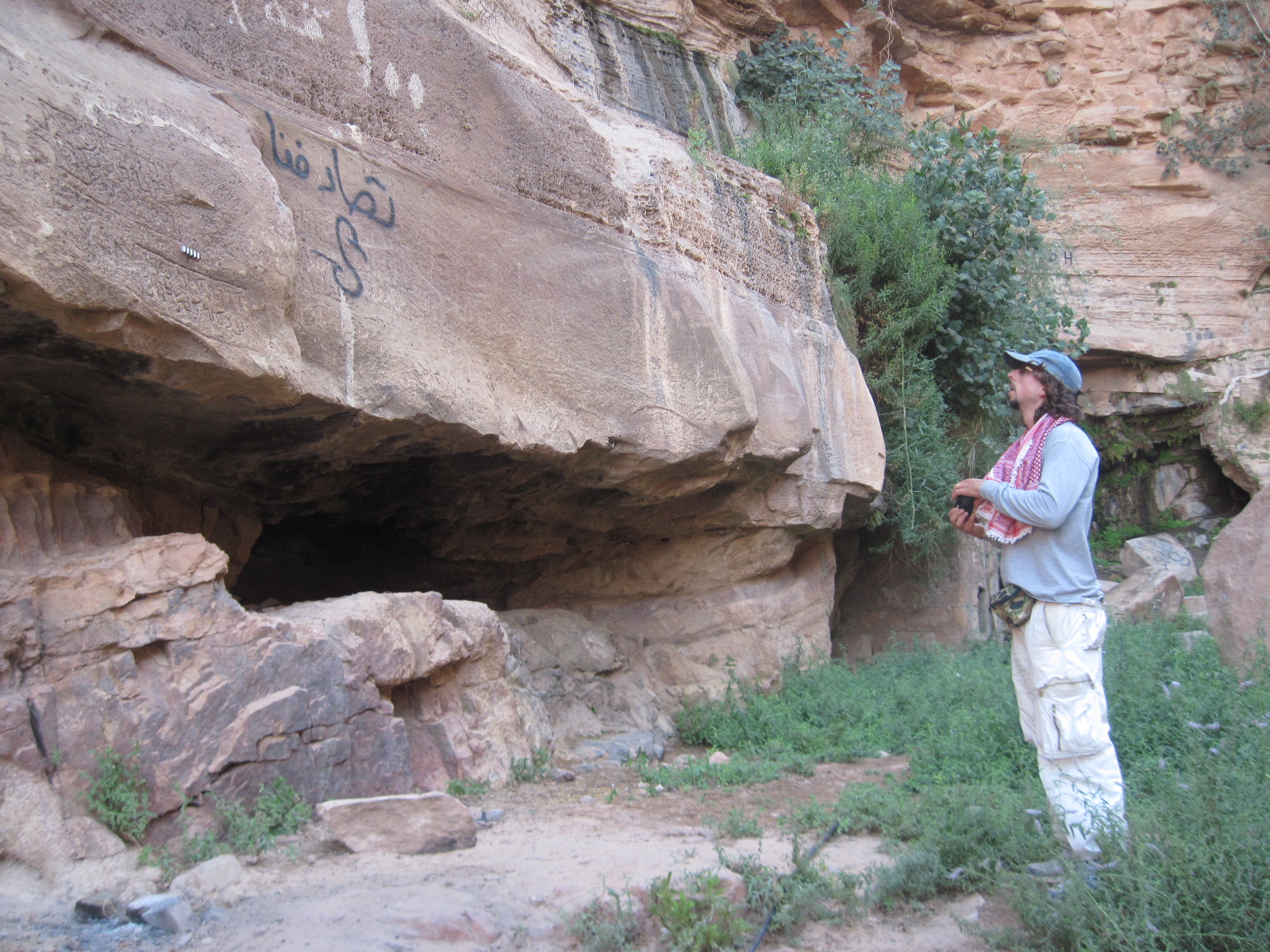
Joey Corbett at the spring with a Nabataean inscription at the far upper left

At sunset we went to a nearby site with an important rock covered with drawings and inscriptions.


Joey and Firas at the rock


A detail of the rock drawings and inscriptions

We spent the night at one of the tourist camps. The next morning Saturday August 25 we went to the Wadi Shirah north of Wadi Rum to see the Umayyad period open-air mosque there with an inscription there dated to Ramadan 107 AH/January 726 AD. Firas had written his MA thesis about the mosque and he wants to publish an article about it, so he and Joey needed to come to take some photographs. We found that the mosque had been badly vandalized recently.


Firas at the south qiblah wall of the open-air mosque


The Arabic inscription at the site dated to 107 AH/726 AD

We returned to Amman that afternoon, stopping at the Ottoman hajj fort at Wadi Hasa on the way back. The entrance was locked, so we could only walk around briefly.

The Ottoman hajj fort at Wadi Hasa


Amman July 17-August 23

On Tuesday July 17 I traveled to Amman, Jordan and moved into the American Center of Oriental Research for another three-month stay. I got a late start in the morning at 9:30 and so ended up having to take an expensive private taxi to the Allenby Bridge. After a long wait on the Israeli side, I eventually got to ACOR after six hours of travel time, one of the longest times the trip has taken.

I was back at ACOR to continue work on the final report of the Madaba Archaeological Park excavations from 1992-1993. But during the first month, I also worked on a variety of other projects. I worked further on Western Accounts of the Masjid al-Aqsa compound in Jerusalem, did some editing of the proposal to have the Baptism Site on the Jordan River nominated as a UNESCO World Heritage Site and proofread further the first of Gustaf Dalman’s volumes about Palestinian customs. I also finished my report about the survey last December of the heritage buildings in Bhimunipatnam, India.

I also did some final work on my translations of the Royal Scientific Society documents about 19th and 20th century Jerusalem for their new website and on Thursday July 26 I attended a meeting at the Royal Scientific Society about the documents – that was the first time I had been on their compound beyond the far side of the University of Jordan since 1994, when I worked for a few months at the Al al-Bayt University liaison office there.

Mohammad Ghosheh, my Palestinian colleague, also came by with a copy of his newly published, spectacular book about the Dome of the Rock.

The Muslim fasting month of Ramadan started on July 21 and ended on August 19, followed by the Muslim holiday of Id al-Fitr, so there were none of the usual public lectures or other events to attend during that time, beyond some in-house presentations by current ACOR fellows, and so I mostly stayed put at ACOR. There are better wireless internet capabilities at ACOR now, and I frittered away a good deal of time live-streaming YouTube videos in the course of the month.

Jerusalem July 1-16

I had traveled to Jerusalem to attend a conference on Jerusalem: Past, Present, and Future held at the Yad Izhak Ben-Zvi Institute. The conference put me up in the Little House in Rehavia hotel, next to the Institute. On my first morning, Sunday July 1, I went to the L.A. Mayer Museum for Islamic Art not so far away, where I had not been since the late 1990s.

The next morning Monday July 2 I went to the City of David archaeological park in Silwan for a guided tour for the conference participants given by Marva Baluka.


Marva Baluka giving the tour

Then we had a tour of the Siloam tunnel by Rony Reich. It was very valuable to understand the results of the recent archaeological work in the tunnel, especially the evidence that shows that the southwest corner of the Herodian temple compound around Robinson’s Arch was one of the last parts to be finished.


Rony Reich explaining the results of his work below Robinson’s Arch

That evening was a dinner for the conference participants and the opening session of the conference. The conference continued on Tuesday, Wednesday and Thursday July 3-5. My presentation about Christians and Muslims in Jerusalem during the Abbasid Period was on Wednesday morning.

On Friday July 6, I moved into the Albright Institute for the next ten days. During my stay I mostly worked on Western pilgrim accounts of the Masjid al-Aqsa compound in Jerusalem and on revisions to my Masjid al-Aqsa article for Humberto da Silveria’s book. I also met Khader Salameh, with whom I am cataloguing the Arabic inscriptions in the Islamic Museum, but I did not get onto the Masjid al-Aqsa compound on this trip. On Wednesday July 11 I went to the Jordanian Embassy in Tel Aviv to get an entry visa for Jordan.

Among other cultural activities, on Saturday July 14 I attended a recorder and guitar concert at the Lutheran Church of the Redeemer in the Old City and on Sunday July 15 I attended a reception and dinner at the Rockefeller Museum hosted by the Israel Antiquities Authority.


Saturday, July 14, 2012

Prague June 30

My two months in Bamberg came to an end on Friday June 29. I traveled from Bamberg via a train to Nürnberg and then a convenient direct bus to Prague, arriving in the evening after four and half hours of travel time. I had passed through Prague for a couple of hours on my way to Bamberg in May and I wanted to take the opportunity to spend some more time there on my way to Jerusalem. Flights from Prague to Ben Gurion Airport were also significantly cheaper than from elsewhere.

I spent the next day Saturday June 30 sightseeing in Prague. I walked around and ended up at the royal castle. I took the full tour, seeing everything there was to see, including the windows of the infamous Defenstration of Prague that triggered the start of the Thirty-Years War in 1618.


The Defenestration of Prague windows

I then walked around some more and went to the Naprstek Anthropology Museum of Asian, African and American Cultures. My fancy was especially taken by a brief video display of Korean breakdancers accompanied by zither (gayageum) players. Over the following days I spent a lot of time watching related videos on YouTube.

I then got a 90-minute subway ticket and rode some of the subway lines until it was time to go to the airport for my flight to Ben Gurion Airport that left at 10:20 pm. The flight arrived at 3:00 am and so I hung out at the airport terminal for a few hours before taking a sherut van to Jerusalem.

Bamberg and Meiningen June 6-29

I continued to live in Bamberg for a second month to continue work on my various Jerusalem research projects. I spent much of my time examining what Western pilgrims and travelers who came to Jerusalem from the 14th to 19th centuries wrote about the Masjid al-Aqsa compound. I also spend some days translating into English a long Arabic document about Jerusalem in the 19th and 20th centuries for a website about Jerusalem being prepared by the Jordanian Royal Scientific Society.

During the month I also met my colleagues Anja Heidenreich and Ilse Sturkenboom to discuss progress on the report of our archaeological survey in the Visakhapatnam District of India last December and plans for a second season this coming December.


On June 6 I went to the nearby city of Erlangen to meet two colleagues of early Christian art and archaeology at the university there: Ute Verstegen and Carola Jäggi.


Ute Verstegen in the university scent garden

The next day June 7 was Corpus Christi Day, a state holiday in Bavaria, marked by a big religious procession through the old city in the morning.


The procession with the offices of the Natural History Museum (where I had my office in 2007) in the background


One of the statues being put back

That afternoon I went to Erlangen again to meet Jürgen Zangenberg, a Hellenistic and Roman historian who is one of the editors of the encyclopedia for which I had written my Roman Jerusalem article last month.


Jürgen Zangenberg, his daughter and me

In the middle of the month was a series of concerts on the theme the Turks Before Vienna; the group Accentus Austria gave two concerts of Austro-Hungarian music. I bought their CD, which I listened to a lot in the following days. Also part of the series was a lecture about Alla Turca music, in which a pianist played a piano with a janissary novelty pedal that produced a thump and rang a bell.


The piano with the janissary element

On Saturday June 16 I joined a day-long nature hike, led by naturalist Hermann Bösch. One highpoint of the trip was him showing us a cluster of some 15 plants belonging to a very rare and endangered species. We also saw an early medieval archaeological site with little to see above the surface.


Hermann Bösch at the find spot of the rare plant.


The group at the archaeological site

On Friday June 22 I had to move out of my apartment because someone else had rented the apartment for the weekend a long time ago. So I went to the city of Meiningen in southern Thuringia, a two-hour train ride away. On Saturday I went to the nearby village of Rohr to visit my two friends Armin and Terini, who were both students of mine in Hyderabad. That evening I attended a performance of Wagner’s early opera Das Liebesverbot, based on Shakespeare’s comedy Measure for Measure at the South Thuringia State Theater. The opera was nice enough, but I could understand why it is only rarely performed. On Sunday morning I went to Meiningen’s Elizabeth Palace museum and the English Garden with its artificial romantic ruins. That afternoon Armin and Terini drove me back to Bamberg and they went on to see the State Garden Show.


The artificial romantic ruins in Meiningen


Armin, Terini and Viktor

Later that afternoon, I went to the nearby town of Ebern and walked around for a couple of hours before returning to Bamberg and moving back into my apartment.


An historic bridge with statues in Ebern


Bamberg May 6-June 5

After the conference in Warsaw I returned to Bamberg for the next two months to continue work on my various studies about Jerusalem. I focused my attention on the accounts of Western pilgrims and travelers who came to Jerusalem from the 14th to 19th centuries, and especially on what they wrote about the Masjid al-Aqsa compound. Hundreds of travel accounts are available for easy downloading via Google Books and archives.org. I also wrote an encyclopedia article about Roman-period Jerusalem and worked on some revisions to my Masjid al-Asqa article for Humberto da Silveira’s forthcoming book of photographs.

I stayed in the same vacation rental apartment where I had lived during my last stay in Bamberg a year ago. I went jogging occasionally in the public park / nature preserve area a short distance from my apartment; I had fallen out of shape once again after the jogging that I had done during last year’s stay.

For the first weeks of my stay in Bamberg I did not travel anywhere out of the city, but I did attend some of the events on World Heritage Day on June 3 and went on May 17, a public holiday for Ascension Day, to the State Garden Show, held on some waste land in a former industrial area that the municipality has reclamated as a public park.


Flowers at the garden show


A musical performance at the garden show with an interfaith relations pavilion in the background

Sunday, May 6, 2012

Warsaw April 30-May 5

I travelled to Warsaw to attend the International Congress on the Archaeology of the Ancient Near East (ICAANE), held at the University of Warsaw. I arrived on Monday April 30 just in time for the first session of presentations in the Islamic Archaeology section. I gave my presentation about Madaba in the Early Islamic Period on Wednesday afternoon.
The weather was sunny and warm the entire time, except for a brief period of drizzle right when the conference group photograph was first scheduled.

May 1 was Labor Day, marked by a political rally and then a parade down the main street past the University.


The rally before the parade


The Labor Day parade

May 3 was Constitution Day, with another parade. Isolated marching bands continued to march down the street for a long time.


A marching band on Constitution Day

I spent the bulk of my time at the conference, which was a good occasion to meet people. I did only a little sightseeing beyond watching the parades; I had done a lot of sightseeing during my stay in Warsaw last year. On Friday, the last day of the conference, I went to the archaeology museum, which I had not seen last year, only to find that the museum was closed on Fridays. So I walked around the adjacent park for a while.


The Krasinskich Park

After the conference ended, I took an overnight train from Warsaw to Prague, arriving at 7:30 am. I had not been in Prague before, so I arranged to stop over for a few hours before continuing on to Germany. I walked around the old city, which reminded me of Bamberg, before returning to the train station, where I took a bus at 11:30 am to Nürnberg and then a train on to Bamberg.


A building façade in Prague